Most lines on most days carry less than they safely could. Dynamic line rating is the fastest way to recover that unused capacity, but getting operators to trust the measurement enough to raise a rating is no easy task.
A higher rating means more current on the line, however if the wind estimate on the weakest span is incorrect, the engineer who approved it owns the result. And the weakest span moves as the weather changes, which makes the measurement harder to trust. So Prisma put that measurement to the test, in an independent, year-long validation with a tier-one European transmission operator.
The Critical Span Sets Your Line Rating
A transmission line can only carry as much as its weakest span allows. One span always runs hotter than the rest, maybe because the wind is lower there, or because the wind hits the conductor at an angle that cools it less. Engineers call it the critical span, and it sets the limit for the whole line.
Find that span and measure it, and you can rate the line with confidence.
The problem is that the weakest span does not stay in one place. As the wind and temperature change through the day, it moves. Across more than 20 utilities and thousands of kilometers, Prisma has found that the critical span shifts position over the course of a day, covering about half the spans on a typical line.
A sensor fixed to one tower reads that spot well, but it tells you nothing about the span that matters an hour later. And putting a sensor on every span costs far too much.
So the critical span keeps slipping into the gaps between sensors, while current flows toward a limit no one can see. The only way to keep that span in view is to measure every span, all the time.
Effective Wind: Even Good Sensors Disagree
Wind is the primary cooling mechanism for an overhead conductor. Small differences in wind speed or wind direction can significantly affect the conductor temperature, the thermal capacity, sag and ground clearance, and the safe operating limit of the line.
That’s why a fair benchmark is needed first to judge any DLR system. The wind that matters most is not simply the wind speed measured near the line. It is the component of the wind that actually cools the conductor, based on:
- Wind speed
- Wind direction
- The angle between the wind and the conductor
Effective wind can vary significantly from one span to the next, even across relatively short distances. If you put two high-quality wind sensors at opposite ends of the same span, they can disagree by about 0.5 m/s. If you move one to a hilltop and the other to a valley 650 meters away, the gap will grow to even 1.4 m/s.
A wide-area weather forecast cannot see those local changes, so forecast-only DLR matches the real line poorly. Measuring effective wind on the line itself, span by span, is what makes a rating reliable.
Reading Per-Span Wind From Your OPGW Fiber
Measuring every span is affordable due to the way the system works. Almost every modern transmission line already carries optical fiber inside its overhead ground wire, known as the OPGW.
PrismaWind reads that fiber. One unit, which we call a Beacon, sits in the substation equipment room and connects to a spare fiber strand. A single Beacon covers 100 to 200 kilometers of line. The install takes about an hour, happens indoors, and needs no outage nor crew on the line.
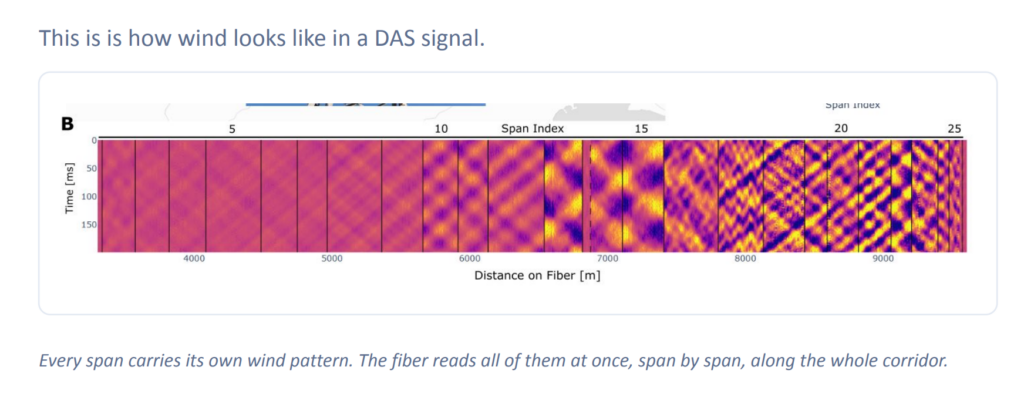
The technology behind it is distributed acoustic sensing. The Beacon sends pulses of light down the fiber and reads the faint light that bounces back. Wind passing over the ground wire creates a small vibration that shows up in that returning light. Trained on years of data, Prisma’s AI reads the pattern for each span and works out the wind speed and angle.
The rest is standard grid engineering. The measured wind goes into the CIGRE heat-balance equation along with weather data to calculate conductor temperature, and that temperature gives a safe rating. One reading, taken from fiber you already own, runs that full calculation for every span.
How We Validated DLR: A One-Year Blind Test
Accuracy claims are easy to make, so a validation has to remove the easy ways to game the result. A trustworthy DLR test comes down to three things:
- Lock the model before testing,
- Compare it against independent reference sensors, and
- Run at least part of the test blind.
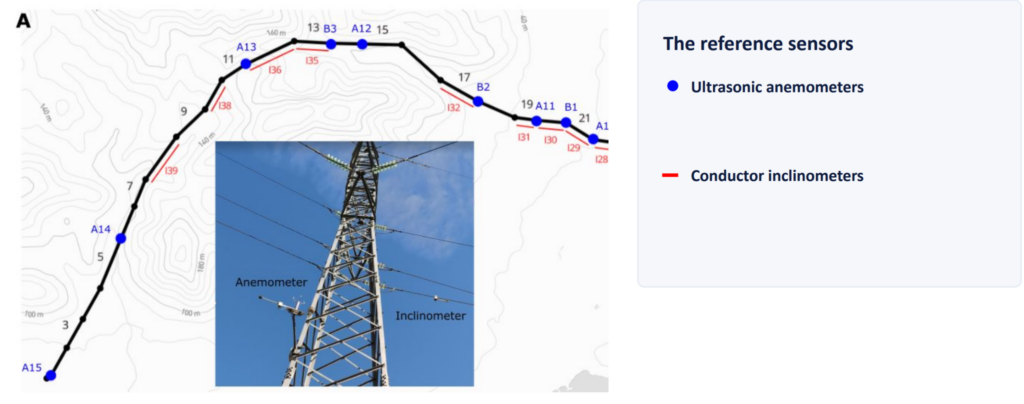
Prisma put PrismaWind through exactly that kind of test with a tier-one European transmission operator. The line was a six-kilometer stretch crossing the coast, a town, and a mountain valley, changing direction along the way, so it covered a wide range of wind conditions. One Beacon in the substation read the whole line. For comparison, the operator installed nine wind sensors and a set of conductor inclinometers along the route.
Prisma connected the Beacon, trained the wind model on about a month of sensor data, and then locked it. Nothing changed after that point, and the training data stayed separate from the data used to check the results.
For the final months, the operator withheld its reference readings until Prisma had already submitted its own, so there was no way to adjust the model to match the answers after the fact. A locked model, checked against independent sensors, with the final stretch run blind, is about as close to an audit as a field test gets.
Blind Test Results: Wind and Conductor Temperature
The wind results met the benchmark that the sensors set. Across the spans it covered, PrismaWind kept its average effective-wind error under 0.5 m/s, with per-span figures between 0.29 and 0.47 m/s, and matched the reference sensors at 0.90 correlation.
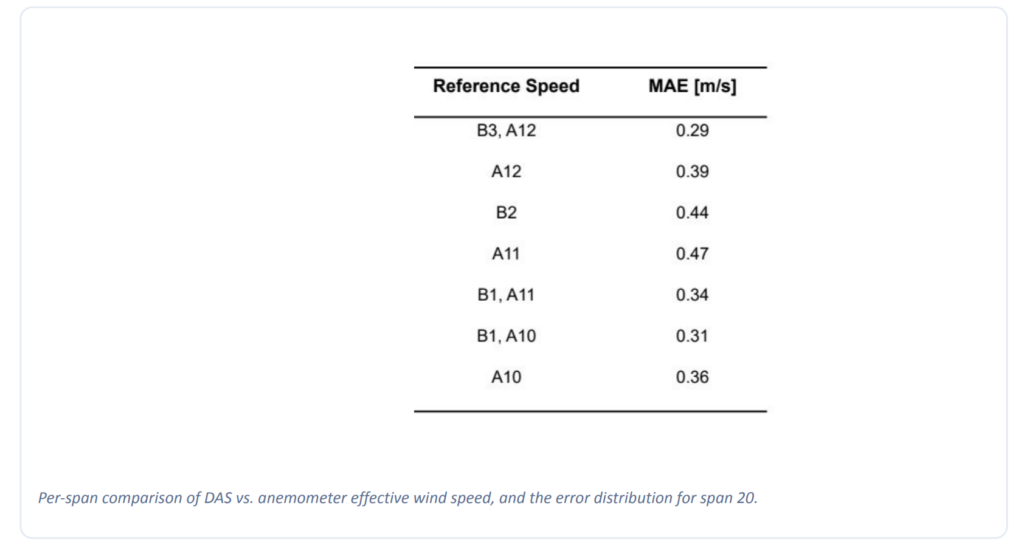
Compare that to the baseline from earlier. The fiber matched the wind sensors about as closely as two good sensors would match each other, and it did so on every span instead of at a few points.
Wind is only the input, so Prisma ran a second, separate check on the result that operators care about: conductor temperature. Prisma ran the measured wind through the CIGRE heat balance to get temperature, then compared it against two independent references, one from conductor sag and one from a direct contact sensor. The results matched about 3°C on average, at 0.92 to 0.96 correlation.
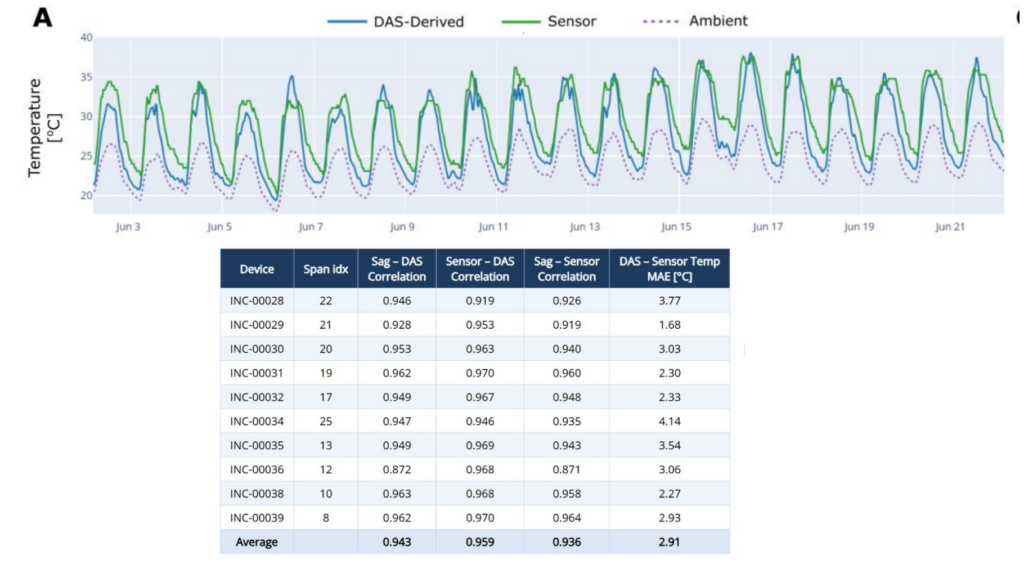
A sag-based reading averages temperature across a whole section of line, which can hide a single hot span inside a cooler average. PrismaWind measures temperature span by span, so the hottest span shows up instead of disappearing into the average. When the rating depends on the weakest span, you need the real number for that span.
More Capacity Under FERC Order 881, With a Safety Margin
The capacity result on the test line is easy to state. The static rating assumed a fixed cooling wind of 0.6 m/s. For much of the day, the real effective wind was two to three times that, and during peak wind hours the conditions supported close to 50% more capacity than the static rating allowed.
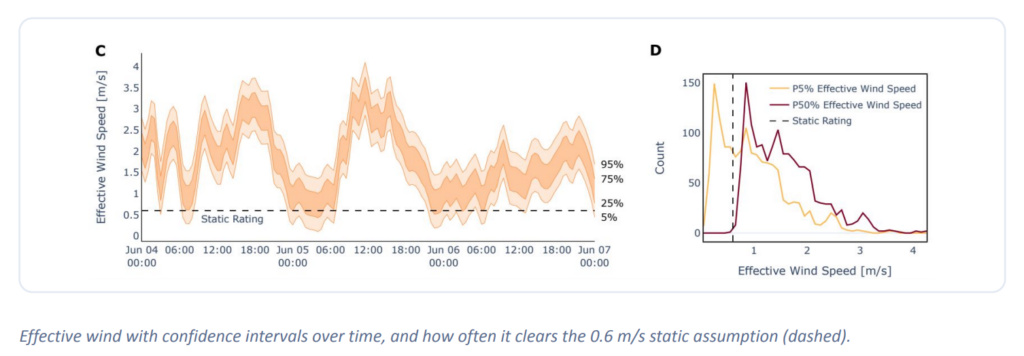
More capacity is not the only benefit. A good DLR system also protects the line. Prisma sets each rating using a careful, low-end estimate of the wind, which leaves a safety margin an operator can check.
When conditions are worse than the static assumption, the rating drops below the static value rather than rising above the conductor’s real heat limit. The line never runs past what it can safely carry.
For compliance, the same measurement supports FERC Order 881 and ambient-adjusted ratings. Ambient-adjusted ratings correct for air temperature but still assume a fixed seasonal wind. Measuring the real cooling wind on every span goes further, rating the line on what the conductor is experiencing right now, with the safety margin stated clearly. So the same fiber reading allows you to make sure you’re FERC 881 compliant and gives you more capacity you can actually use.
Dynamic Line Rating on the Lines You Already Own
Dynamic line rating earns its keep on the lines that constrain you most. If those lines already carry OPGW fiber, PrismaWind can read them with nothing installed on the line itself.
The same fiber can also feed PrismaClimate and PrismaCircuit over time, flagging events like wildfire, high wind, lightning, and tampering, so one connection can serve both capacity and resilience.
Prisma already works with more than 20 leading transmission operators across the US and Europe. To see how the same approach could apply to your grid, book an intro call with Prisma Photonics, and we will walk through your most constrained lines and how the measurement works, span by span.