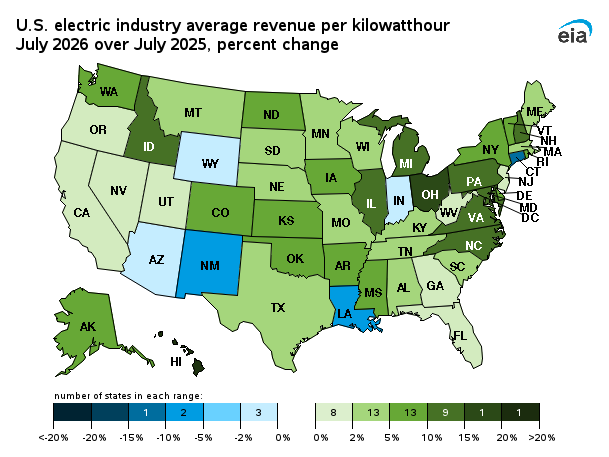
Electricity keeps getting more expensive, and utilities carry the pressure to hold the line on cost. In July 2026 the average U.S. residential price reached 18.31 cents per kilowatt-hour, up 4.9 percent in a year, according to the EIA. Across 44 states and the District of Columbia, customers paid more than the summer before.
Regulators and member-owners now question every spend. The most affordable capacity a utility can add is the headroom already sitting on lines it owns. Dynamic line rating puts that headroom to work, with no new build, no new right-of-way, and no heavy capital outlay.
Demand is climbing at the fastest pace in decades, with data centers and electrification driving the strongest four-year run of electricity growth since 2000, yet a new line still takes close to a decade to build, so meeting that load on existing lines defers a capital build that would otherwise land on rates.
There is faster capacity available, and it already hangs between the towers. The question is how much of it a utility can safely use, and what that costs next to pouring concrete for a new corridor.
How a utility can add transmission capacity without building a new line
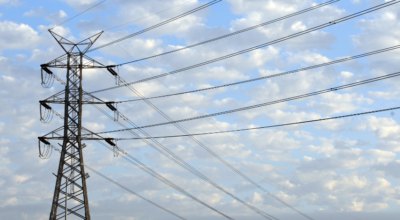
Most high-voltage lines carry a static rating, one fixed number that assumes the worst case: a hot, still day with the sun full on the conductor. Those conditions rarely hold up. On a cooler or windier hour, the same conductor can carry considerably more current without passing its thermal limit.
Dynamic line rating measures what the line is actually experiencing and sets the rating to match. The headroom it frees up is real. Idaho National Laboratory found that accounting for wind cooling can safely raise a line’s capacity by 10 to 40 percent, and utility demonstrations have shown as much as a quarter more usable capacity for much of the time.
The economics follow. Releasing existing headroom runs at a small fraction of the cost of rebuilding a line, needs no new right-of-way, and arrives in months rather than years. Reconductoring and a new corridor add capacity too, but both cost more and take far longer, which makes dynamic rating the fast first move. (More on how distributed DLR finds the capacity already in your lines.)
For a system operator weighing how to meet near-term demand, the order of operations changes. Before committing capital to a new line, measure how much the existing one can safely carry.
Where dynamic line rating saves money under cost-of-service
The savings show up in two places: the power a utility buys and the capital it can defer:
- Congestion is the first. When a line fills up, the grid cannot deliver the cheapest generation, so operators dispatch costlier plants instead. Grid Strategies put the national bill for that at roughly 17 billion dollars in 2025. A rating that reflects real conditions lets more low-cost power move on the lines already in place, and some of that 17 billion stays with the utility and its members.
- Curtailment tells the same story from the other side. When a local line is full, operators cut output from wind and solar that is ready to deliver. In 2024, CAISO curtailed 3.4 million megawatt-hours of wind and solar, up 29 percent from the year before, and the EIA attributes most of it to local transmission congestion rather than oversupply. The power was available and paid for, and the line could not carry it.
- Deferred capital is the second. A rebuild or a new corridor carries a large price tag and a multi-year timeline. Reading more capacity out of an existing line costs a small fraction of that and arrives in months, which can push a capital project years down the road or off the plan entirely.
The honest obstacle is the business model. The WATT Coalition points out that cost-of-service regulation rewards large new builds over getting more from existing assets, so the incentive has long run the other way. The pressure is changing now. Regulators and member-owners increasingly ask what each dollar buys, and an operating-cost measurement with no upfront capital is an easier case to defend than another concrete pour.
Prisma’s commercial model fits that shift. A Pay-as-You-Grow subscription carries no upfront sensor capex, so a utility can prove the value on a few lines before scaling across the system.
Cost pressure bites hardest at the utilities with the least room to spend: the cooperatives and public power systems.
How a co-op or public power utility can get more from its grid on a tight budget
Cooperatives and public power authorities answer to member-owners and local boards, and every spend has to earn its place. A big capital build is the hardest thing to justify and the slowest to deliver.
Existing-asset capacity fits that constraint well. The method costs a fraction of a rebuild, needs no new right-of-way, and returns usable headroom in months rather than years.
The lighter the field footprint, the better the fit, and this is where the approach varies by vendor. Some dynamic-rating systems mount sensors on the conductors or towers, which means hardware to install, power, and maintain on every line, often with outages or specialized crews.
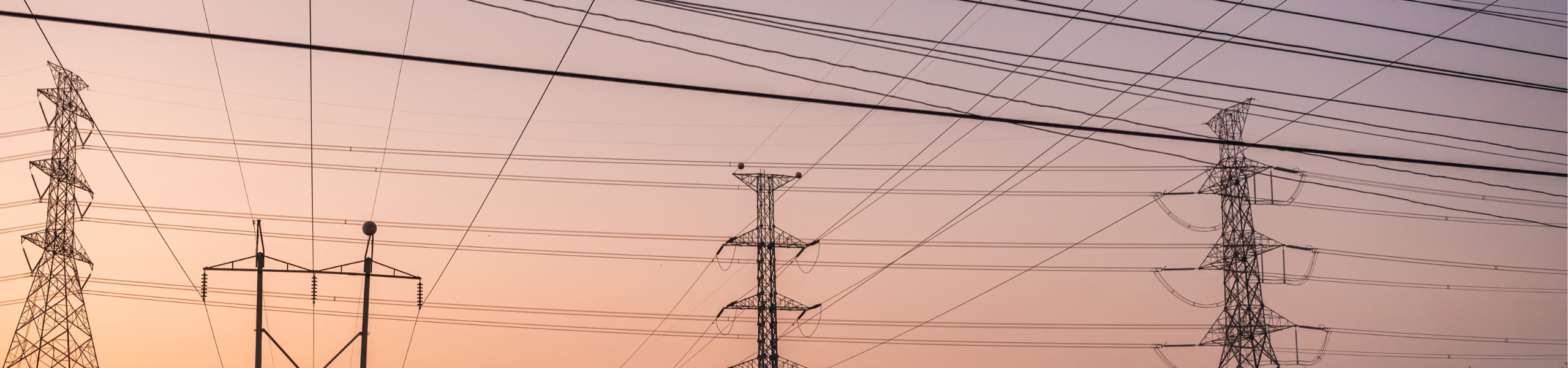
Prisma takes a different route. Most high-voltage lines from the 1990s onward already carry optical ground wire, which runs along the top of the towers for lightning protection and communications. One fiber inside it becomes a continuous sensor along the whole line. An interrogator unit at the substation sends light pulses down the fiber and reads the vibration and temperature at every span, so the utility measures wind cooling directly rather than guessing it from a distant weather station.
No crew mounts anything in the field, and no new equipment needs power, calibration, or an outage to install. For a utility watching its budget, that removes the hardware bill, the helicopter time, and the maintenance load that come with sensors on the line.
The capacity is already on the wire. Reading it takes equipment at the substation and the fiber the utility already owns.
Multi-use grid monitoring from one fiber
The affordability case gets stronger when one deployment covers several needs. The fiber that measures capacity for dynamic line rating also locates faults, flags icing and wildfire risk, and watches for physical interference on the line.
A utility pays once to read the fiber and puts that reading to work across resilience, capacity, and security. A single-purpose sensor earns its keep on one job, while the same spend here spreads across several, which lowers the cost of each capability and makes the business case easier to carry to a board.
The more a utility asks of its grid, the more that matters.
See what your lines can already carry
Before the next capital plan locks in a new build, it is worth knowing how much the existing lines can safely hold on a normal day. For most systems the line can safely carry well above its static rating, and the gap is capacity the utility has already paid for.
Prisma reads that capacity with fiber-based dynamic line rating, using equipment at the substation and nothing new on the towers. We can map it against your own corridors and show where the headroom sits.
If your team is weighing how to add capacity without a new build, let’s compare notes on what your lines are carrying today.