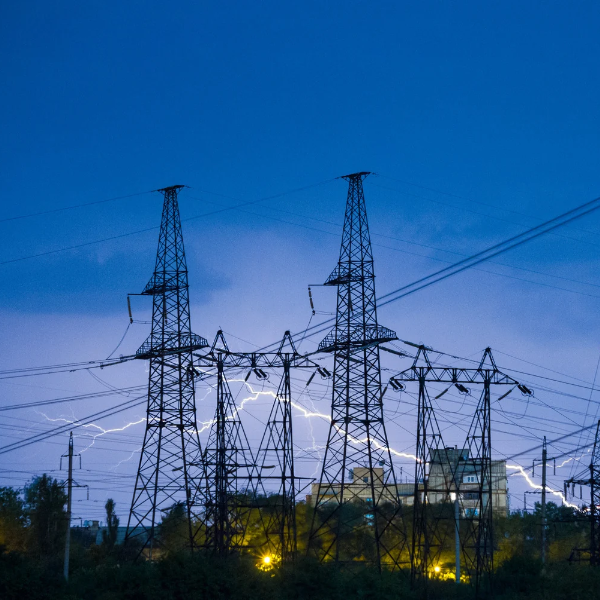
Grid reliability keeps the power steady on an ordinary day. Grid resilience keeps it recoverable on the worst one. Utilities often treat the two as one word, and that blur hides a real weakness, because a grid can look reliable and still be brittle. Aging lines, thin real-time visibility, and harsher weather all widen the gap. Power line monitoring on existing fiber is how utilities start to close it, strengthening grid reliability and grid resilience from the same signal.
Grid Resilience and Grid Reliability: Definitions and Similarities
Grid reliability is the grid’s ability to deliver steady, dependable power under the conditions you expect day to day. Grid resilience is the grid’s ability to absorb a shock it did not expect, like an ice storm or a downed line, and recover fast when something does break.
The two sit close together, which is why people use them interchangeably. They share an objective, a dependency, and a payoff from the same technologies.
| Grid reliability | Grid resilience | |
| Core question | Can we keep the power flowing under normal conditions? | Can we take a hit and recover quickly? |
| Measured by | Outage frequency and duration, meeting expected demand | Speed and completeness of recovery after a disruption |
| Typical threat | Equipment wear, load peaks, routine faults | Storms, wildfires, physical attacks, rare extreme events |
Start with what they have in common, because that shared ground is where monitoring earns its keep.
- Same objective. Both exist to keep a stable, continuous power supply reaching customers. One guards the everyday, the other guards the bad day, and neither matters to a customer who just wants the lights on.
- Same underlying need. Both depend on healthy infrastructure. A transmission line with a developing fault, a corroded joint, or a hotspot is a reliability problem on a calm day and a resilience problem when the storm arrives.
- Same payoff from smart technology. Both improve when operators can see more and act sooner. Better visibility means fewer failures and quicker response times, whichever lens you apply.
So the goal is shared. Where reliability and grid resilience split apart is in what they ask of the system, and that is where the useful distinction lives.
Key Differences Between Grid Resilience and Grid Reliability
A grid can post excellent reliability numbers and still be brittle. The difference shows up along four lines.
- Focus. Reliability is about ensuring a consistent, dependable supply. Grid resilience is about recovering from disruptions when they land. Texas makes the gap concrete. The state’s grid failed during the 2021 winter storm and again during the 2023 heat wave, leaving millions exposed both times. Reliability asks whether the grid should have withstood those conditions in the first place. Grid resilience asks how fast power comes back once it goes down. In Texas, both answers came up short, which is exactly why treating them as one word hides the real weakness.
- Time horizon. Reliability is a day-to-day performance measure, judged on how the grid behaves this hour and this season. Grid resilience works on two timescales at once: the immediate scramble to restore power when something breaks, and the long-term job of hardening the system against the next event.
- Response to disturbances. Reliability works to prevent disruptions and hold continuous service. Grid resilience assumes some disruptions will get through anyway and works to limit the damage when they do.
- Adaptability versus consistency. Grid resilience values adaptability and flexibility in the face of uncertainty. Reliability values consistency and predictability in delivering electricity. A reliable grid does the same dependable thing every day. A resilient grid changes its behavior to survive a day it has never seen before.
Hold those four apart and a pattern appears. You cannot adapt to, respond to, or recover from a disturbance you cannot see, which is where the hardest challenges start.
Why Achieving Grid Resilience and Reliability Is Important
When the grid falters, the cost lands far outside the utility. Three stakes stand out:
- Public health and safety. Hospitals, dialysis clinics, water treatment, and home medical equipment all assume the power stays on. An outage during a heat wave or a deep freeze turns from an inconvenience into a danger for the people least able to cope with it. Grid resilience is, in plain terms, a public-safety function.
- Economic stability. Outages are expensive twice over: the business activity lost while the power is down, and the emergency repairs to bring it back. Reactive fixes after a failure cost far more than catching the same problem early, and a grid that fails repeatedly erodes the confidence investors and large energy users place in a region.
- Enabling modern technology. Broadband, data centers, electric transport, and a growing share of electrified industry all need a stable grid underneath them. As demand climbs, the grid becomes the floor everything else stands on, and a shaky floor limits what can be built on top of it.
The case for both is clear. Delivering on it is where utilities keep running into the same walls.
Challenges in Achieving Grid Resilience and Reliability
Three obstacles show up on almost every utility’s list:
Aging infrastructure. Much of the transmission network was built decades ago, and older assets fail more often and bend less under stress. The North American Electric Reliability Corporation has warned that the U.S. is at heightened risk of rolling blackouts as old power grids struggle with extreme weather and rising electricity demand. Replacing that infrastructure is the obvious answer, and also a slow, costly one, which pushes utilities to get more out of the assets already standing.
Limited real-time visibility. You cannot respond to what you cannot see. Across hundreds of kilometers between substations, most operators have only a thin picture of what is happening on the line right now. That blind spot makes it hard to anticipate a developing fault or localize a disturbance before it becomes an outage.
Extreme weather. Hurricanes, storms, wildfires, icing, and heat waves all damage infrastructure and trigger widespread outages. No surprise, then, that grid resilience ranked among the top priorities for utility leaders. A Guidehouse and Public Utilities Fortnightly survey put a number on it: 61% of utility respondents named increasing flexibility to improve energy system resilience as their single highest-priority investment outcome.
There is a fourth pressure worth naming: the grid is now a target. NERC’s E-ISAC logged more than 3,500 physical security breaches across the U.S. in 2025, and GridEx 2025, the industry’s biennial security exercise, drew roughly 28,000 participants, its highest turnout since 2019. Vandalism, ballistic attacks, and drones have moved grid physical security from an afterthought to a resilience question in its own right.
Each of these challenges points back to the same gap: not enough eyes on the line. That is what the next generation of monitoring sets out to close.
Strategies for Enhancing Grid Resilience and Reliability
No single tool fixes both at once, but a handful of approaches move the needle on reliability and grid resilience together.
Fiber-optic sensors. Optical fiber already runs alongside much of the transmission network, often as the ground wire strung atop the towers. Turning that fiber into a sensor gives operators a continuous read on the line itself, and because it is glass rather than electronics on the conductor, it holds up through the harsh weather that knocks out other equipment.
Smart grid technology. Smart meters and distributed energy resources get most of the attention, but power line monitoring is the piece that speaks directly to resilience. Watching the high-voltage lines in real time, rather than waiting for a fault to announce itself, is what shifts a control room from reactive to proactive.
Predictive maintenance. Catching a developing fault, a hotspot, or a weakening joint before it fails turns an emergency repair into a scheduled one. That is cheaper, safer, and far less disruptive, and it is only possible with data coming off the line continuously.
Stakeholder collaboration. Utilities, regulators, and vendors moving in step is what turns a pilot into a standard. Regulation plays a part here too: FERC Order 881, in force since July 2025, pushes U.S. utilities toward more accurate, dynamic line ratings, and getting there rewards the same real-time visibility that resilience depends on.
These strategies share a common thread, which is better data from the line itself. That is the thread Prisma Photonics pulls on.
How Prisma Photonics’ Power Line Monitoring Improves Grid Resilience and Reliability
Prisma Photonics turns the optical fiber already on the line into a continuous sensor, no new hardware on the conductors or towers. One connection at the substation reads strain, temperature, and vibration at every point along hundreds of kilometers of line. The goal is to make the world’s infrastructure safer, smarter, and more resilient, and here’s where power line monitoring does that work.
Real-time monitoring. Operators see the whole line as it behaves right now, not a handful of sampled points. That continuous view is what closed the visibility gap for the New York Power Authority, where the system flags icing on line spans in real time so crews can act before the ice damages the asset. Icing is a textbook resilience threat, and catching it early is the difference between a managed response and an outage.
Early fault detection. Faults, short circuits, and partial discharge get caught and located as they develop, down to the nearest tower. Pinpointing the spot in real time is what turns a multi-hour hunt across the line into a targeted dispatch.
Predictive maintenance. A continuous record of how each span behaves lets utilities fix the weak point on their schedule rather than on the storm’s. That lifts reliability on the calm days and resilience on the hard ones at the same time.
Renewable integration. More wind and solar means a more variable grid, and a variable grid needs stronger situational awareness to stay stable. The same monitoring layer that watches for faults also gives operators the real-time picture they need to absorb renewable generation without sacrificing reliability.
Put those together and the payoff is straightforward: better grid performance day to day, faster response when a fault does appear, and healthier infrastructure over time through maintenance that is planned instead of reactive. One fiber, watching every span, serving reliability and grid resilience from the same signal.
See the Whole Line, Strengthen Both
Reliability and grid resilience are different jobs, but they draw on the same thing: knowing what is happening on the line at every point, all the time. The blind spot between substations is where the ice forms, the fault builds, and the intruder arrives first, and it is the spot most grids watch least.
Power line monitoring on the fiber you already own closes that gap without putting a single new device on the conductor. Speak to us today to find out how much of your network you can watch in real time, and turn the fiber already on your lines into a layer that strengthens reliability and grid resilience at once.